Smoke detectors: chirping bonds, silent stocks
Smoke detectors: chirping bonds, silent stocks


Smoke detectors, while lifesaving, can remind you of their existence at the most inopportune times. On Sunday night, one of them started chirping at 1 AM. So I got up, grabbed batteries, and climbed a step stool to silence it. 2 hours later, another one let us know it needed the same thing. This time it was my partner’s turn to address it. While the rest stayed silent, we spent a solid 30 minutes the next day replacing their batteries. Sleep is too precious.
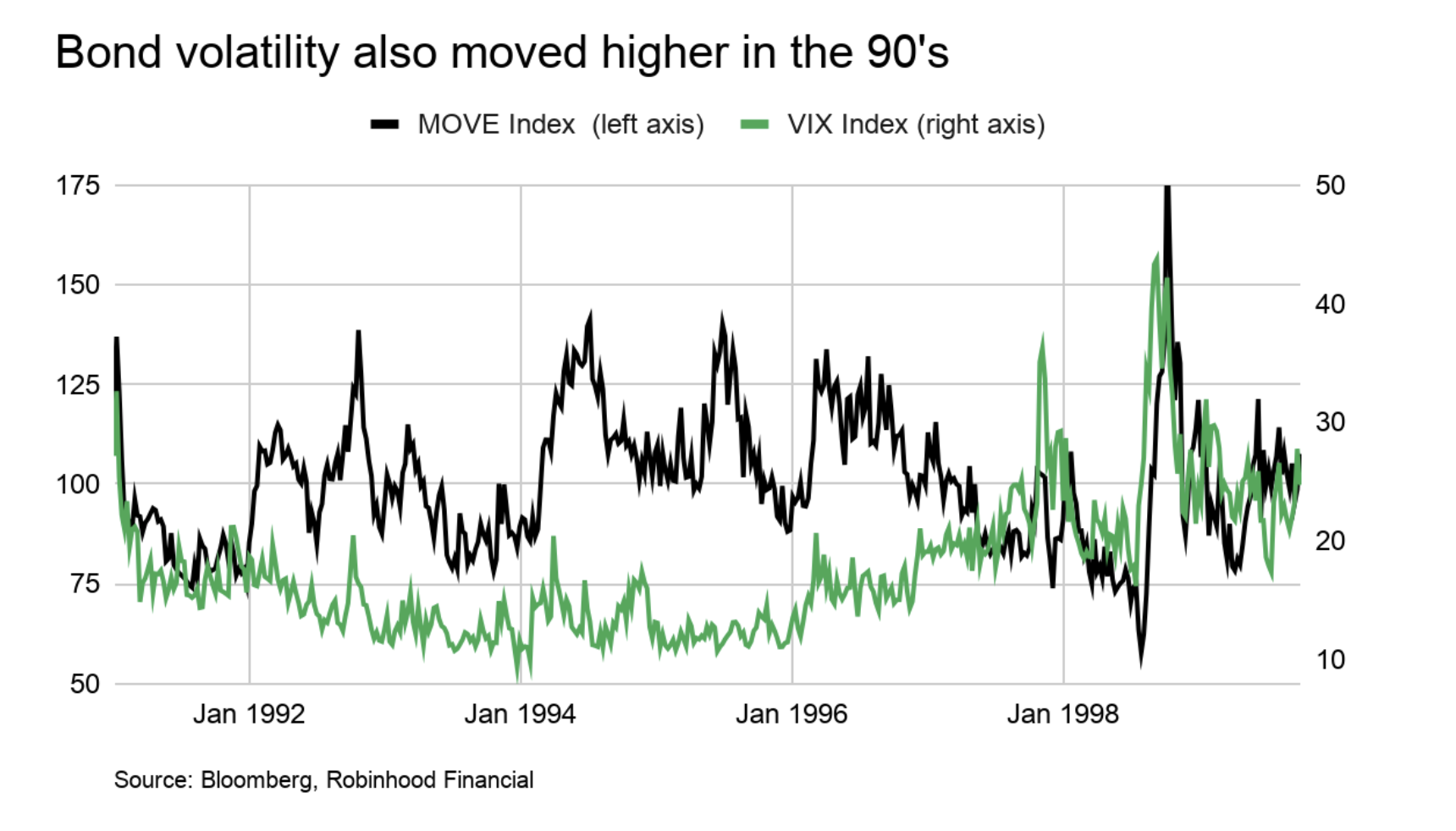
I’ve thought about how this experience is apropos to the market we are in right now. For example, the bond market is chirping: the MOVE index, which tracks expected Treasury volatility, jumped about 35% in September, a move seen 8 times since 2008. The stock market’s version, however, is quiet: the VIX is sitting in the mid-teens, with the S&P 500 hovering near its highs.

Next week, we may start to find out which way it could go. Q3 earnings season kicks off Tuesday, October 13, with banks like JPMorgan, Wells Fargo, Citi, and Goldman Sachs reporting before the open. After a quarter that gave us the first Fed hike since 2023, a 10-year yield around 5.25%, a nominal GDP growth of over 6% (the highest since 2005), a payrolls print of just 29,000 jobs, and consumer sentiment at 48 (near the lowest level in 50 years), here are 4 questions we could be asking:
Banks: did higher rates help more than weaker credit hurt?
Banks should generally like higher rates, especially on longer term rates vs. short term rates, since they can reprice loans faster than deposits. But this quarter has a wrinkle. The Fed's hike came September 16, so it only touched the last 2 weeks of the quarter, as you can see in the chart below. Guidance on banks’ net interest margin will be important.

On the other side of the ledger, unemployment ticked up to 4.2%, and July and August payrolls were revised down by a combined 60,000. In addition, private credit deals banks have gotten involved in, may start to look not so good with higher rates. So provisions (money set aside for losses) are also important. Essentially, how much of the interest income is getting spent on provisions for potential credit losses? And what are net charge-offs vs. last quarter? For reference, Citi's provision was $2.5 billion in Q2.
Energy: did the oil windfall show up, and is it repeatable?
Companies such as Exxon, Chevron, and Occidental report later this month, and Q3 should look strong on paper given that oil prices rose by over $20 per barrel.

But earnings are a rearview mirror. WTI was around $90 on Monday, and Europe recently agreed to release about 100 million barrels of diesel as Middle East exports pick back up. If supply is healing, Q4 could face a much tougher comparison.
Capex plans and buyback pace will tell us what these companies actually believe could happen with their businesses.
AI: has the spending started to translate to productivity yet?
Software companies such as ServiceNow and the hyperscalers report in the second half of October. In early September, I wrote about how Nvidia and other large tech firms are behaving more like a bank, extending equity, guarantees, and purchase commitments to keep its customers building. If that's right, proof of productivity matters more, because someone is underwriting that credit.
What I’d like to see: AI-related revenue starting to grow at a faster rate than capex, and operating margins holding. And referring back to the "torpedo" bucket from my late September piece, many of the software names were shown to have prices down double digits, while the Street still models positive earnings growth. So guidance is a good test. If enterprises are getting real productivity, it should show up in their bookings, not just in the chip companies' backlogs.
The consumer: did the retrenchment show up, and where?
The Michigan consumer sentiment index fell to 48, which is lower than where the index stood at the start of each of the 6 recessions since 1978. Weakness in the volumes of everyday staples vs. premium brands is the point where "squeezed" can start to sound like "recession." Which we don’t have yet.

And YTD, the consumer discretionary sector is down 6.4%. Is consumer sentiment already somewhat reflected in prices? Retail sales did rebound 1.2% in August after July's 0.5% decline. PepsiCo and Delta give us an early read this week.
Finally, does the gap between bond and stock volatility have to close now?
It doesn't have to close mechanically. These two measure different things, and right now they have different drivers.
The bond market is repricing the cost of money. Real yields account for a lot of the 100+ basis point rise in the 10-year this year, so it's not all an inflation-expectations story. It's about demand for capital, from governments and from AI funding. Even when Friday's payrolls missed expectations, yields initially dipped, then gave it all back, and the 10-year finished near 5.25% again.
Stocks, meanwhile, are calm at the index level but not underneath. Morgan Stanley pointed out that more than half of Russell 3000 stocks are down 20% or more, while the index sits near its highs. When stocks move in different directions, index volatility stays low even if individual stocks are having a rough time.
But stocks and bonds share an input. The 10-year is the discount rate on nearly every stock. So I think the gap closes 1 of 3 ways:
1. Bond volatility comes down. This needs a catalyst. CPI on October 14 and the Fed on October 28 are the next 2, and markets still see better-than-even odds of another hike in December.
2. Equity volatility goes up. Earnings guidance is how equity vol gets new information.
3. The gap stays, because dispersion keeps the index calm. That's possible.
The mid-to-late ‘90s had the same relationship, where the swings in the bond market were bigger than those in stocks. And it finally resolved with stock volatility rising to meet bonds, and bond volatility eventually dropping as rate hikes kicked in.