Robinhood Custodial Accounts
Invest as they grow
Open a Robinhood custodial account (UTMA) for a child and start investing in their future—so what you set aside today can grow over time.

Flexible access to funds
Access funds anytime for expenses that support the child’s growth.

Potential tax benefits
In some cases, a 0% tax rate may apply to a portion of unearned income.

Easy handoff process
Transfer the account to them in just a few steps when the time comes.
Make gifting easy
for loved ones
Share a secure link so loved ones can send cash, stock, or ETF gifts—even without a Robinhood account.

Your strategy.
Or Robinhood Strategies.
Learn more about custodial accounts
What is a custodial account?
A custodial account is an investment account opened and managed by an adult (the custodian) for a minor (the beneficiary).
Custodial accounts on Robinhood are governed by the Uniform Transfers to Minors Act (UTMA), with certain legacy Uniform Gifts to Minors Act (UGMA) features preserved by state law. While the custodian manages the account, the assets legally belong to the minor and are intended to benefit them.
Who owns a custodial account?
The minor beneficiary is the legal owner of the account.
The custodian controls the account until the minor reaches the account’s age of termination, typically 18 or 21 depending on the state where it is created, at which point the account automatically transfers to the beneficiary.
KEEP IN MIND
A custodial account must be opened while the beneficiary is still considered a minor under the UTMA law governing the account.
Who can open a custodial account?
To open a custodial account on Robinhood, you must:
- Have an active US Robinhood individual account
- Be W-9 certified
- Be able to provide the minor’s:
- Full legal name
- Social Security number
- Date of birth
- Residential address
- Be able to certify the minor’s tax status on their behalf
- Open the account before the minor reaches the applicable age of majority under the governing state’s UTMA law (typically the state where you or the minor lives)
You don’t need to be the minor’s parent or legal guardian to open a custodial account, as long as you can provide the required information.
Can I open more than one custodial account?
Yes. You can open multiple custodial accounts, including:
- Multiple accounts for different minors
- Multiple accounts for the same minor
Each custodial account has one custodian and one beneficiary. A single custodian can have up to 10 custodial accounts total.
Can family and friends contribute to a custodial account?
Yes. You can share a gifting link that allows family and friends—even those without a Robinhood account—to contribute to a custodial account. You can choose to accept cash, stock, or ETFs as gifts from those you share the link with. The gifting link for the custodial account will be present on its dashboard.
What’s available with a custodial account?
Custodial accounts support many of the same investments as standard Robinhood accounts, with some restrictions.
Supported
- Stocks and ETFs
- Recurring investments
- Recurring deposits
- Dividend reinvestment (DRIP)
- High-yield cash
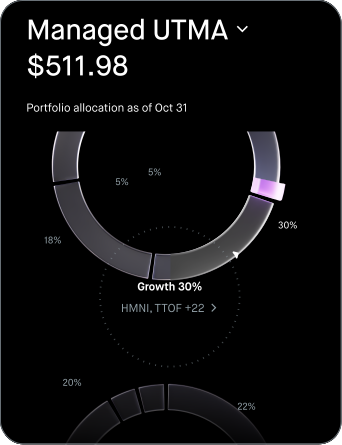
- Managed custodial accounts (via Robinhood Strategies)
Not supported
- Options trading
- Futures and event contracts
- Short selling
- Crypto
- Margin investing (margin is enabled on managed custodial accounts to allow for immediate reinvestment of any sale proceeds)
Keep in mind, what we support may change in the future.
What can I use UTMA funds for?
You can use UTMA (custodial) funds for any expense that directly benefits the minor.
Under UTMA rules, money and assets in a custodial account legally belong to the minor and must be used for the minor’s benefit, not the custodian’s. There are no restrictions that limit spending only to education.
Examples of permitted uses
UTMA funds can generally be used for:
- Education expenses (tuition, books, tutoring, supplies)
- Medical and dental expenses
- Childcare or summer programs
- Specialized housing-related costs that benefit the minor (i.e. summer programs, student housing)
- Technology or equipment for school or skill development
- Other reasonable expenses that support the minor’s wellbeing
Important limitations
- Funds can’t be used for the custodian’s personal expenses or for ordinary parental support obligations
- Withdrawals must be defensible as benefiting the minor
- Assets transferred into a custodial account are irrevocable and can’t be moved back to a non-custodial account
- Once the minor reaches the account’s age of termination, the funds and assets are transferred to the beneficiary, who can use them for any purpose
This flexibility is a key difference between UTMA custodial accounts and more restricted accounts like 529 plans, which limit withdrawals to qualified education expenses.
How are custodial accounts taxed?
Custodial accounts are owned by the minor beneficiary and taxes are reported under the minor’s Social Security number, not the custodian’s. Robinhood issues tax forms in the beneficiary’s name.
Under federal "kiddie tax" rules, a portion of the minor’s unearned income may receive favorable tax treatment. Check out IRS Topic 553 or consult with a tax professional for more information.
What happens when the minor reaches adulthood?
When the beneficiary reaches the account’s age of termination (usually 18 or 21, depending on the state):
- The beneficiary creates an individual account in their name after which assets are automatically transitioned to this account
- The custodian’s access is restricted until the beneficiary claims the assets (by creating an individual account)
- After the transfer is complete, the custodian’s access is removed and the custodial account is deactivated
- Assets remain invested unless the beneficiary chooses to sell
- All optional features such as recurring investments, DRIP, SLIP, and High-yield cash will be paused on the account until the beneficiary claims the assets in their own individual account
This transfer can’t be delayed or blocked by the custodian.
Can I choose the age when the account transfers?
In some states, you can choose the age of termination (for example, up to age 25). In other states, the age is fixed by law.
The age of termination is set when the account is opened and can’t be changed later, even if you or the beneficiary move to another state. The following table shows examples of states where the age of termination differs.
| State | Allowed transfer age under UTMA law |
|---|---|
| California | 18 by default, optionally extendable up to 21 |
| Florida | 21 by default, optionally extendable to 25 |
| New York | 21 by default, optionally reducible to 18 only |
| Illinois | 21 (no flexibility) |
| Tennessee | 21 by default, optionally extendable up to 25 |
NOTE
A custodial account must be opened while the beneficiary is still considered a minor under the UTMA law governing the account.