What is a Stock Split


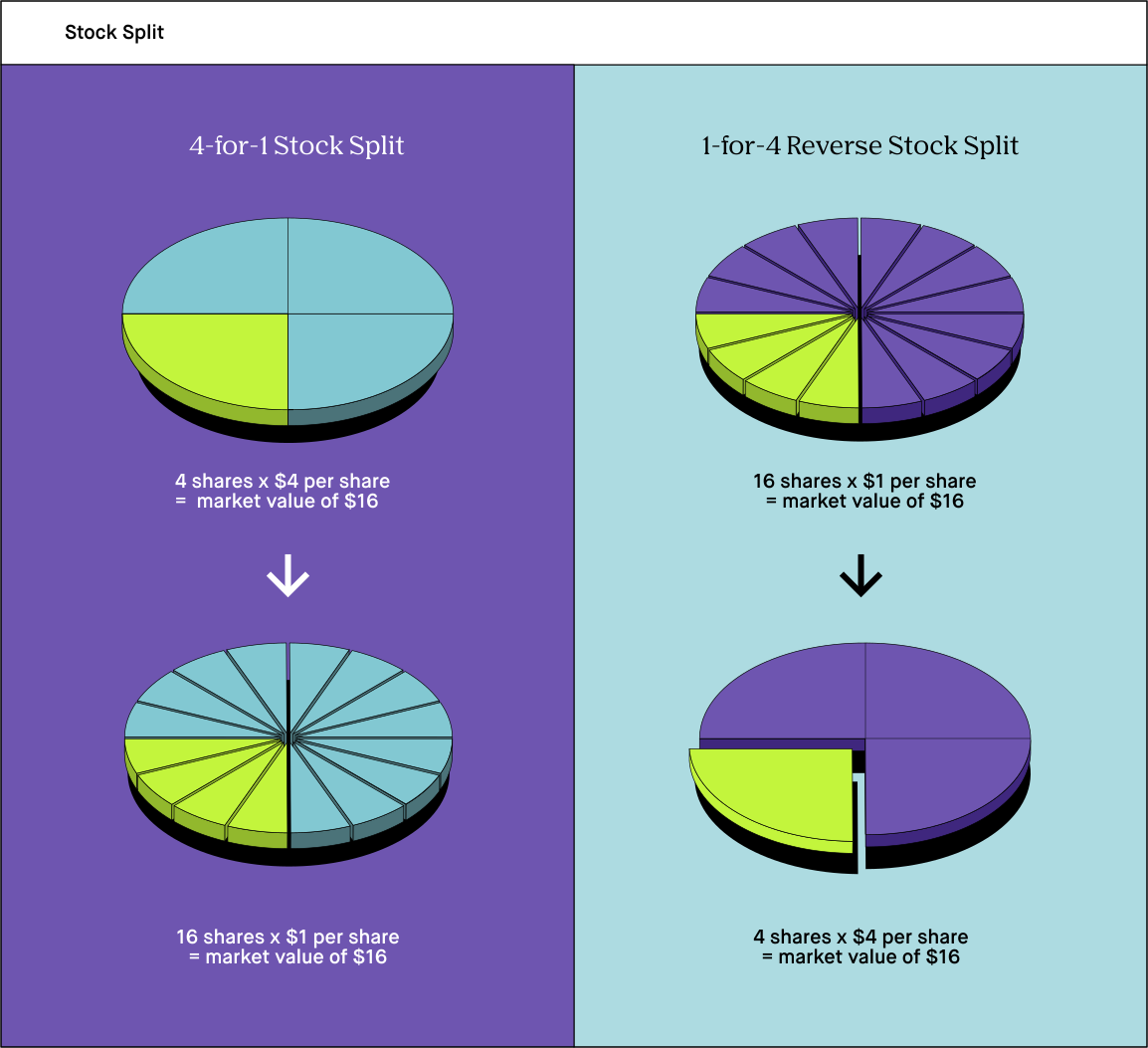
A stock split makes a company’s shares more affordable, keeping the company’s overall value the same while dividing its existing shares into a greater number of smaller, less expensive shares. (A reverse stock split does the opposite, combining shares to raise a company’s stock price.)
🤔 Understanding a stock split
Stock splits (and reverse stock splits) are often about psychology. Their purpose is to make an individual stock cheaper (or more expensive) by adjusting the number of shares available. On paper, this doesn’t affect the company’s overall value, but it can help improve liquidity (aka the speed and ease with which someone can trade a stock), by making it easier for investors to trade shares.
In the case of a stock split, a company’s board of directors may determine that their shares appear too expensive to potential investors. So, the board might decide to cut the share price in half and double the number of shares outstanding. For each share you owned before the split, you’d receive two, proportionally less expensive shares after. (This would be a 2-for-1 split.) For a struggling company though, a reverse stock split might be useful — That is, combining shares to push the stock price higher. For instance, in a 1-for-4 reverse split, you would receive one, more expensive share for every 4 shares you owned before the reverse split.
Ultimately, for existing investors, the result is the same. The number of shares you own and their individual price may change, but stock splits (and reverse stock splits) don’t actually change the total value of your investment.
Apple has a long history of stock splits. In fact, since the company went public in December 1980, its stock has split five separate times.
Slicing up Apple
- June 16, 1987: 2-for-1 split
- June 21, 2000: 2-for-1 split
- Feb. 28, 2005: 2-for-1 split
- June 9, 2014: 7-for-1 split
- August 31, 202: 4-for-1 split
That means if an investor had purchased and held one share of Apple at its IPO in December 1980, they would have owned 224 shares after Apple’s August 2020 4-for-1 stock split. Here's the math: 1 share became 2 after the 1987 split, 4 after the 2000 split, 8 after the 2005 split, 56 after the 2014 7-for-1 split, and finally 224 after the 2020 4-for-1 split.
Takeaway
Yogi Berra nailed it...
Cut my pizza into 4 slices — I’m not hungry enough to eat 8. Hold up, Yogi! It doesn’t matter how you cut it, the pizza is still the same size! This captures the same effect of a stock split: The number of underlying shares (or slices) changes, but the company itself is no different because of the split. Unlike a pizza though, over time, a company might grow or shrink, for instance, as it explores new business lines or faces production difficulties. These shifts could influence whether the company pursues another split, or considers a reverse split.

New customers need to sign up, get approved, and link their bank account. The cash value of the stock rewards may not be withdrawn for 60 days after the reward is claimed. Stock rewards not claimed within 60 days may expire. See full terms and conditions at rbnhd.co/freestock. Securities trading is offered through Robinhood Financial LLC. Futures trading offered through Robinhood Derivatives, LLC.
What’s a “reverse” stock split?
If companies that are doing well and have pricey shares pursue stock splits, then what do distressed companies do? Well, they can do the opposite. If a company is worried that its stock seems too cheap, it might consider a “reverse split” — That is, combining shares to raise its stock price. You might think of it like rolling together two smaller pieces of playdough into one larger ball. The amount of clay you have is exactly the same, but it’s now one bigger blob. Likewise, a company that goes through a reverse split has a smaller number of more expensive shares (but the underlying business is unchanged).
So, why do reverse splits happen? There are many possibilities. A company’s management team might think that their share price seems low compared to industry peers and competitors. They might even worry that a seemingly low-priced stock reflects poorly on their company’s potential. Another concern could be getting delisted from a stock exchange. Some exchanges, like the New York Stock Exchange, require a $1 per share minimum (and a company rarely wants to get kicked out of the club).
Regardless of whether you’re examining stock split, or a reverse stock split, here’s one thing to keep in mind: Ultimately, the market value of a publicly traded company is measured by its market capitalization, which is stock price multiplied by the number of shares outstanding.
What’s a real-life example of a reverse stock split?
Blue Apron, the meal-kit pioneer, is an example of a company that went through a reverse stock split. In June 2019, its shares fell below $1, trading at about $0.55 apiece. That was cheap. Too cheap, if you asked Blue Apron's Board of Directors. In fact, it was so cheap that the New York Stock Exchange (NYSE), where the shares were listed, warned Blue Apron that if its stock price didn't rise above $1, it could face delisting. If that happened, Blue Apron stock could have been moved to the less accessible over-the-counter (OTC) market.
To address the issue, Blue Apron's Board of Directors approved a 1-for-15 reverse stock split. For every 15 shares an investor owned, they received 1 new share, while the share price increased proportionally.
Blue Apron's reverse stock split helped the company regain compliance with NYSE listing requirements, but it did not solve the underlying business challenges facing the company. In the years that followed, Blue Apron continued to struggle with profitability and competition. Eventually, the company was acquired and taken private in 2023.
Blue Apron's story highlights an important lesson for investors: a reverse stock split can raise a company's share price, but it does not change the fundamentals of the business. While some companies successfully recover after a reverse split, others continue to face operational and financial challenges. That's why investors often look beyond the split itself and focus on whether the company's underlying business is improving.
So what’s the difference between stock split and a reverse stock split?
Here’s how the processes differ.
Stock split
- A company wants a lower stock price so its shares are more affordable to investors.
- So, the company splits its shares. To cut the share price in half, it would pursue a “2-for-1” or “2:1” stock split. Shares could split into even smaller pieces. To reduce the share price to one-eighth, for example, a company could pursue a “8-for-1” or “8:1” stock split.
- A 2-for-1 split doubles the number of shares. An 8-for-1 stock split multiples the number of shares by 8.
- The total value of the company doesn’t change — It’s the same pizza, which has been cut into smaller slices.
Reverse stock split
- A company wants a higher stock price so that it doesn’t get delisted from an exchange.
- So, the company combines shares in a reverse stock split. To double the stock price, it would pursue a “1-for-2” or “1:2” reverse stock split. To increase the stock price by a multiple of six it would do a “1-for-6” or “1:6” reverse stock split.
- A 1-for-2 reverse stock split halves the number of shares. A 6-for-1 reverse stock split reduces the overall number of shares by a factor of six.
- The total value of the company doesn’t change — It’s just a pizza that’s been cut up into fewer slices.
Who approves a stock split?
A public company’s board. Since stock splits and a reverse stock splits are corporate actions, they usually require the approval of the board of directors. Typically, the board is comprised of 8 to 12 individuals who have been elected to represent shareholder interests. Just as we saw with Blue Apron’s reverse stock split, the board is responsible for voting on whether a split should occur, factoring in whether it’s beneficial for shareholders. Once the vote is held and a date and ratio are chosen for the split, the company announces its plan.
What are some common stock splits?
There are plenty of ratios a board can choose from when they pursue a stock split. Some possible stock splits are 2-for-1, 3-for-1, and even 3-for-2. Reverse stock splits follow a similar pattern, except in reverse (i.e., 1-for-2, 1-for-3, or 2-for-3). You might also see them written with colons, like 2:1 or 1:2.
But there is one real-world difference to keep in mind. Since reverse stock splits often aim to raise a stock’s price , they often use larger numbers. For example, you may come across 1-for-7 reverse splits, or even 1-for-15 (as we saw with Blue Apron).
More dramatic splits and reverse splits also have the benefit of longevity. The bigger the split, the less likely it is that you’ll need to engage in another split sometime in the future.
How are investors affected by a split?
This is the fascinating element about stock splits and reverse stock splits — They barely affect existing investors. This corporate action is more of a psychological game the company plays with potential future investors who might be concerned about the stock’s price. Because a stock split or reverse stock split changes the number of shares and the price of the shares in an inverse proportion, the overall value of the company stays the same.
Need help with a stock split? Check out our Help Center.
New customers need to sign up, get approved, and link their bank account. The cash value of the stock rewards may not be withdrawn for 60 days after the reward is claimed. Stock rewards not claimed within 60 days may expire. See full terms and conditions at rbnhd.co/freestock. Securities trading is offered through Robinhood Financial LLC. Futures trading offered through Robinhood Derivatives, LLC.