What is a Correction?


A correction is a reduction in the price of an index or market by at least 10% (but less than 20%) over days, weeks, or months.
🤔 Understanding corrections
A correction is usually defined as the price of a group of securities (a financial instrument like a stock or bond) dropping by between 10% and 20%. The term is most often used to describe a group of stocks such as the S&P 500, NASDAQ, or Dow Jones Industrial Average. A reduction that’s less than 10% is considered normal volatility. If the price falls by more than 20%, it’s called a bear market. Historically, corrections have happened in the US stock market about once every three years, followed by a period of growth. However, the timing and eventuality of future corrections and recoveries is not guaranteed.
On January 3, 2022, the S&P 500 closed at a record high of 4,797 for the year. Then, as the US Federal Reserve started to signal the need for 50 to 75 bps rate hikes in the near future, concerns about the economic ramifications set in. On February 22, 2022, the market entered correction territory, closing at 4,304 — Marking a 10.3% fall from 50 days earlier. The correction turned eventually in a bear market in June. Later, the Fed took dramatic intervention steps and raised the Fed rate hike in June by 75 bps for the first time since 1994.
Takeaway
A correction is like the saying “what goes up, must come down”...
A ball can defy gravity for a little while when you throw it into the air. But eventually, it loses momentum and falls back to the ground. That’s kind of how stock prices work. They can be overvalued for a little while, but eventually, they can fall back to what the market fundamentally supports.
New customers need to sign up, get approved, and link their bank account. The cash value of the stock rewards may not be withdrawn for 60 days after the reward is claimed. Stock rewards not claimed within 60 days may expire. See full terms and conditions at rbnhd.co/freestock. Securities trading is offered through Robinhood Financial LLC. Futures trading offered through Robinhood Derivatives, LLC.
What is a correction?
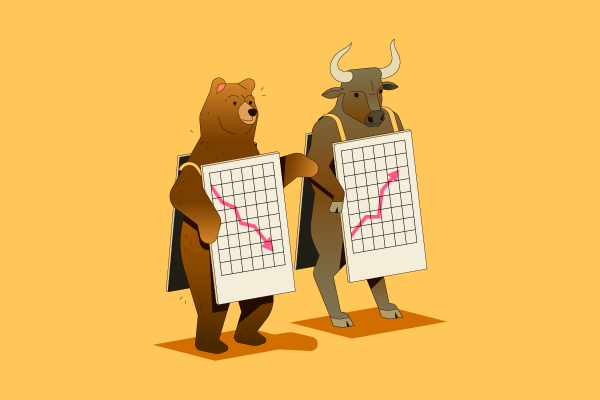
In finance, a correction is a dramatic fall in the stock market following a period of overvaluation. It generally refers to a situation where the stock market increases too much, then falls back down to a level traders feel is a correct value. Most often, a 10% reduction over more than one day is classified as a correction. If the correction continues, it can turn into a bear market — A reduction of more than 20%. In some circumstances, a correction might correspond to a recession in the economy.
How does a correction work?
Generally speaking, the stock market declines in value when more investors want to sell than buy at the current price. In some situations, if traders believe that stocks are overvalued, the falling price can trigger fear. That might make other investors want to sell at the new lower price before the price falls even more. With the added sellers, the price drops further. This feedback loop can cause the stock market’s value to fall until investors think that the lower price is a good deal.
In other situations, a change in the market’s conditions can alter the value of stocks. For example, an increase in corporate taxes would imply that companies will keep less of their profits. Stock prices are a reflection of a company’s profitability, meaning that a tax increase should, in theory, reduce the market value of owning shares of common stock. If this change was significant enough, the updated value of a company might dip more than 10% below its previous price. And if that happened, the stock market would need to correct the prices to account for the new reality.
What is the difference between a correction, a crash, and a recession?
When the stock market falls by at least 10% over several days, weeks, or months, it's called a correction. By contrast, a market crash is an abrupt drop in value over just a few days. A crash usually happens when traders in a market bid up the price of a security based on expected price increases, without corresponding improvements in the company’s profitability to support the higher price (aka a speculative bubble).
When the bubble pops, traders may panic and try to sell their holdings. But there usually aren’t enough buyers willing to take them, causing the value of these securities to fall quickly during the sell-off. There are many well-known crashes in the US stock market — Some of the more recent occurred in 1929, 1987, 2008, and 2020.
A recession is a decline in the value that an economy creates, which is usually measured as two or more consecutive declines in the gross domestic product (the value of all the things an economy produces). Not all stock market corrections or crashes mean that the entire economy will collapse. That said, since the stock market is a reflection of the listed companies’ profitability, changes in the stock market often do reflect changes happening (or sometimes more importantly expected to happen) in the rest of the economy.
Can you predict a correction?
Nobody can reliably predict what the stock market will do next. If one person knows what is about to happen, that likely means other traders do too. And when many people position themselves in anticipation of something, they tend to move the market price. In other words, if you could predict a correction, you probably wouldn’t be able to take advantage of it, because everyone else is trying to do the same.
Since corrections can happen when the stock market is overvalued, when market values rise to a certain point traders might start to worry about a correction. But the reality is that pinning down the peak is likely impossible. If a trader waits years for a correction to happen, they might miss out on massive gains in the meantime.
How should investors prepare for a correction?
All investing comes with risk. One common way to mitigate risk is through portfolio diversification (an approach that involves spreading out your investment across a range of different kinds of securities, through asset allocation). Diversifying has the potential upside of reducing the magnitude of aggregate investment losses from an event like a correction from being as severe as they might, if, say, all of your investments focused on stocks.
Depending on how risk-averse an investor is, they might put more money in relatively lower-risk, lower-yield investments, such as bonds or other income-focused investments. Long-term investors typically adopt an investment strategy that balances their risk tolerance and return targets. Since corrections tend to be shorter-term events, investors with long time horizons typically don’t do much to prepare for a correction, and instead hope to ride it out.
Keep in mind, however, diversification does not ensure a profit or guarantee against loss.
Is the stock market due for a correction?
At just about any point in time, at least one person is saying the market is due for a correction while others are explaining why that person is wrong. The reality is that there's no way to know how long it will take before a correction happens.
New customers need to sign up, get approved, and link their bank account. The cash value of the stock rewards may not be withdrawn for 60 days after the reward is claimed. Stock rewards not claimed within 60 days may expire. See full terms and conditions at rbnhd.co/freestock. Securities trading is offered through Robinhood Financial LLC. Futures trading offered through Robinhood Derivatives, LLC.